
Most distributors treat a company store the same way: stand it up, load a catalog, and hope orders come in. The store is an afterthought, the thing you give away to win the apparel business.
That's the mistake. The distributors making real money on programs treat the store as a system, not merch with a website attached. What they're selling is control, compliance, and insight. The products are almost incidental.
Here's what that shift looks like.
Do the math on what a program costs you
Say a program does $250k in product sales a year. Your product net cost is $150k, so you're sitting on $100k gross. Feels healthy.
Now subtract what it takes to run the thing. Here's a rough, illustrative model for that same program. Your real numbers will differ, but the shape holds:
- E-commerce platform. Most stores run on a SaaS platform with a monthly fee. Call it around $6k a year.
- End-customer support. A good program answers buyer questions, chases stuck orders, and handles returns. Even a fraction of a CSR's time lands around $15k a year.
- Card processing. Roughly 3% of $250k is about $7.5k a year.
- Inventory space. If you're holding product, that's square footage, shelving, and handling. Call it around $8k a year.
- Build and upkeep. Setup, catalog changes, and the developer or contractor hours to keep it running. Easily $10k a year and up.
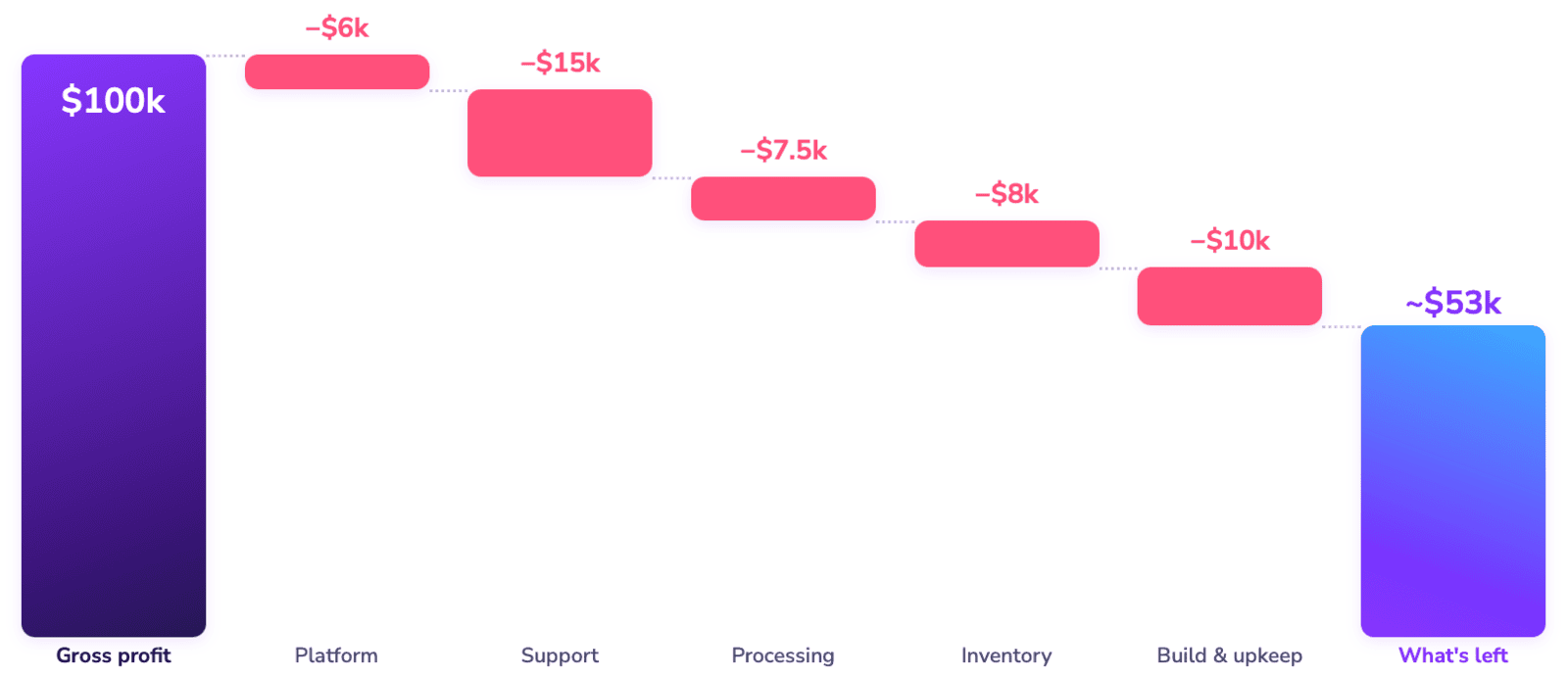
That's already north of $45k, and it doesn't include your own team's time on sales, account management, and accounting. Pinning down the exact overhead on any one program is hard, because most of these resources are shared across many stores rather than dedicated to a single one. But do the math even roughly and you'll often find the net profit on a program isn't what the gross made it look like. Set the store up as a free perk that rides along with the order, and every one of those costs comes straight out of your margin, invisibly, month after month.
You can't price a program you haven't costed, and it's easy to run a store for years without ever stopping to do it.
Charge for the program, not just the product
Once you see the store as a system you operate, the way you charge changes.
Product margin is one line. The program itself is another. A monthly program fee reflects that you're running infrastructure, not just filling orders. Per-product setup reflects that some items take real work to configure, and that work isn't free. Catalog changes are labor, so they get billed like labor.
One move worked well for us when I was on the distributor side. We charged for store setup and hosting up front, but tied it to a minimum annual spend commitment. Hit the commitment, and we rebated those costs back. That one structure filtered out the prospects who just wanted services for free, put a real dollar figure on the value we were providing, and still let us give a lot away to the clients who were genuinely invested. The people who balked at paying for setup were usually the same ones who were never going to drive real volume.
None of this means squeezing the client. It's the opposite. Bury your service costs inside product margin and your sales team ends up defending your product price against the big guys on every order. Break the services out and product can stay competitive, the services get positioned as the value they are, and your team keeps room to flex where it makes sense. Keep product pricing transparent, and stop handing over the operational work for free.
One test worth keeping: if your program grows and your margin doesn't, your pricing model is broken.
Know what kind of store you're actually running
A pop-up for a single event and an always-on replenishment store are not the same product, even when they run on the same platform. A B2C store lives and dies on UX and conversion. A B2B store with multiple buyers and approval chains lives on reporting and controls. A redemption store built on points or allowances needs configurations the others never touch.
Get this wrong at the start and you pay for it during the entire life of the program. Store type dictates the UX, the fulfillment, and the reporting. Decide it deliberately, up front, not after launch when changing it means rebuilding.
Don't let the client design it
When a client hands you a feature list, you've already lost a little ground. They're describing the solution they pictured instead of the problem they have.
Start with the problem. Then map it to approaches you already know how to build, support, scale, and price. Complexity should be earned. You can solve the hard, custom, color-outside-the-lines problems too, but only when the deal is worth it. A phased v1 that delivers real value beats a sprawling custom build that ships late and breaks often.
Reporting is the part that gets you the renewal
This is the piece most distributors skip, and it's the one that keeps programs alive.
A store that just moves boxes is easy to replace. A store that shows a stakeholder exactly where their spend is going, by user, by location, by department, is not. Good reporting turns "we bought some shirts" into "here's what's working, here's where adoption is strong, here's what we should do next." That's what earns the renewal, the expansion, and a seat at the table when the client plans next year.
The throughline
Every program that scales does the same four things. It's profitable to operate, easy for users to adopt, and visible to the stakeholders who fund it. And it's actively managed and evolved, not launched and forgotten.
Miss any one of those and the program quietly dies, usually right around the time you were hoping to renew it.