Every distributor gets to this question eventually. Do we stay on software built for promo? Or do we move to a broader ERP?
If you own the business, this is bigger than a tech purchase. You are deciding how work moves through the company. You are deciding whether growth creates leverage or simply creates more administrative work.
The real issue is operational friction. Teams spend enormous amounts of time copying data between systems, cleaning spreadsheets, chasing approvals, re-entering orders, fixing bad syncs, and answering questions that software should already know the answer to. A little friction is manageable. At scale, it becomes expensive.
And scale is exactly what many distributors are chasing. ASI reported that North American promotional-products distributor sales reached a record $27.7 billion in 2025. PPAI reported continued growth across the industry. But growth alone does not create healthy operations. In many cases, rising revenue simply exposes weak systems faster.
I keep coming back to the same conclusion: the future belongs to operators. The companies that scale well are the ones that pair strong sales with disciplined systems, clear processes, and intentional automation.
First, Define the Two Paths
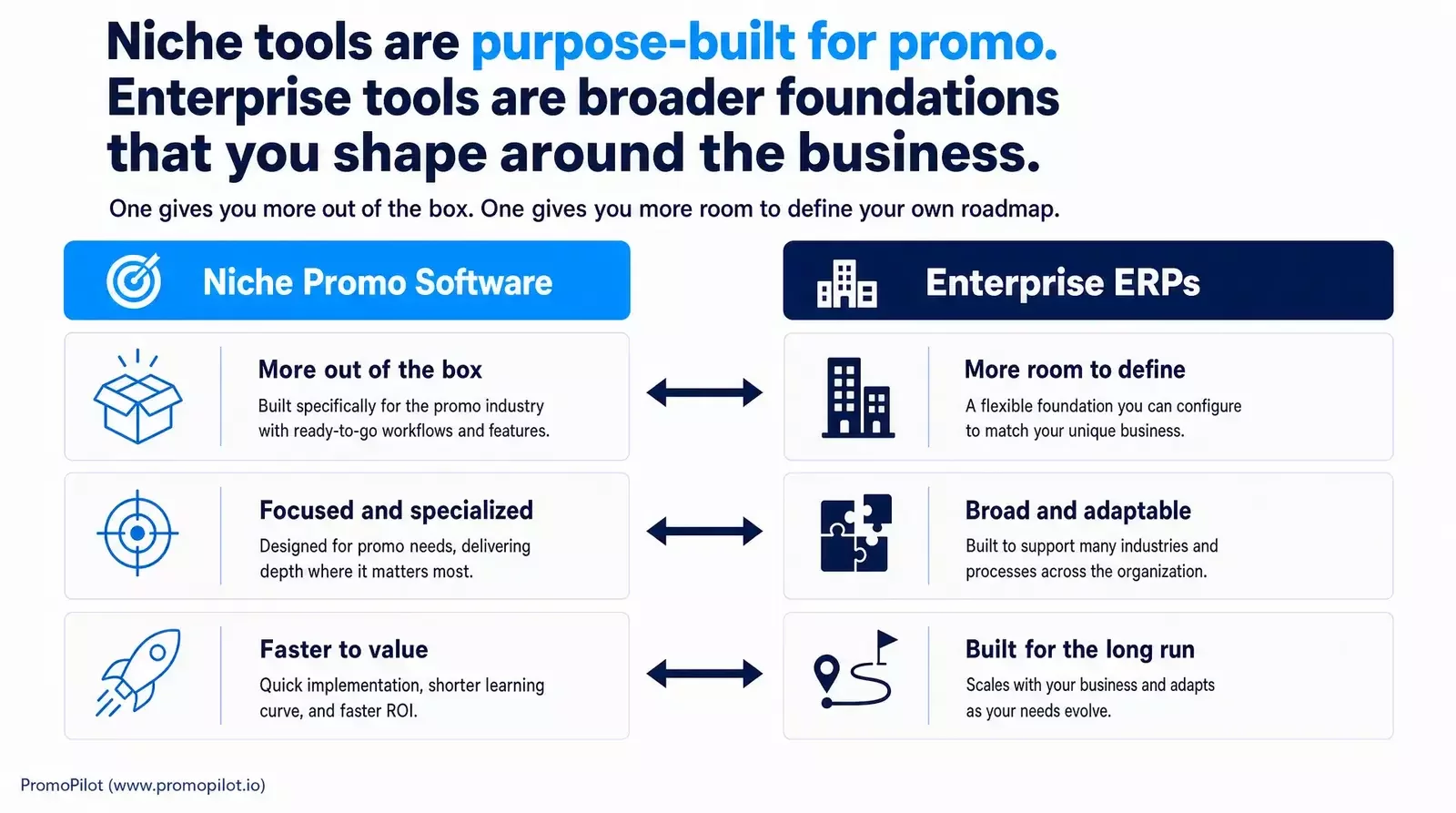
When I say niche software, I mean industry-specific platforms like commonsku, Antera, and MPower Promo. When I say enterprise ERP, I mean broader systems like Zoho One, NetSuite, Odoo, and Business Central.
Niche tools are purpose-built for promo. Enterprise tools are broader foundations that you shape around the business. One gives you more out of the box. One gives you more room to define your own roadmap.
That is the cleanest way I know to frame it. After this point, I am going to keep it generic, because the bigger issue is how these categories behave once your business starts to grow.
Why This Choice Carries More Weight Now
This decision mattered five years ago. It matters more now.
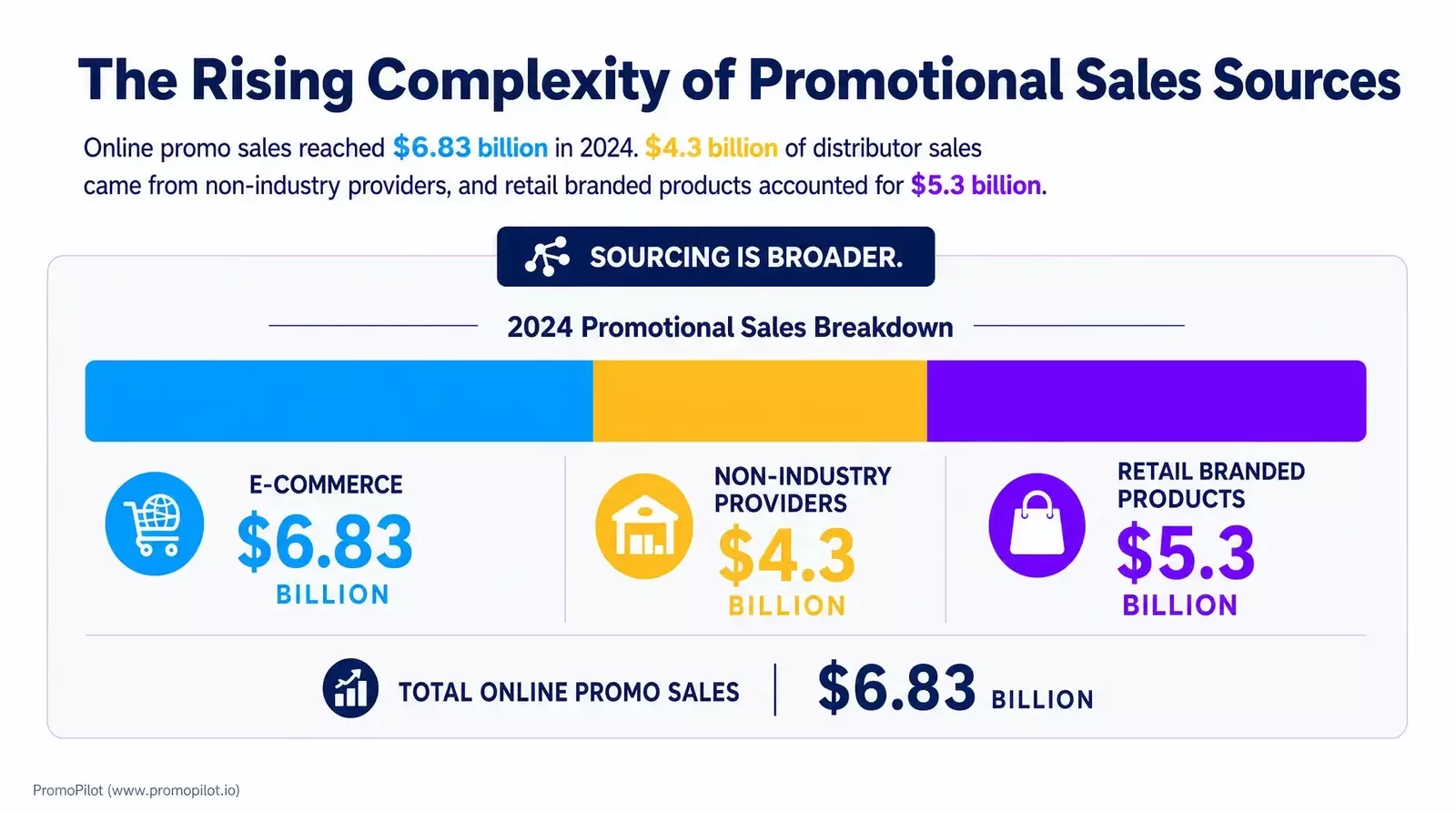
PPAI reported that online promo sales reached $6.83 billion in 2024, representing 25.5% of total industry sales. The same report found that 84% of large distributors and 60% of small distributors were selling online. Online inventoried company stores alone generated $2.35 billion. Ecommerce is no longer a side channel. For many distributors, it is core infrastructure.
At the same time, the work itself is becoming more complex. PPAI reported that $4.3 billion of distributor sales came from non-industry providers, while retail branded products accounted for another $5.3 billion. Distributors are sourcing from more places, supporting more program types, and managing more exceptions than they were a decade ago.
That is where software starts to matter in a very practical way. The platform underneath your business either helps absorb that complexity or pushes it back onto your team through manual work, disconnected systems, and operational overhead.
Why Niche Software Keeps Winning
The Good News
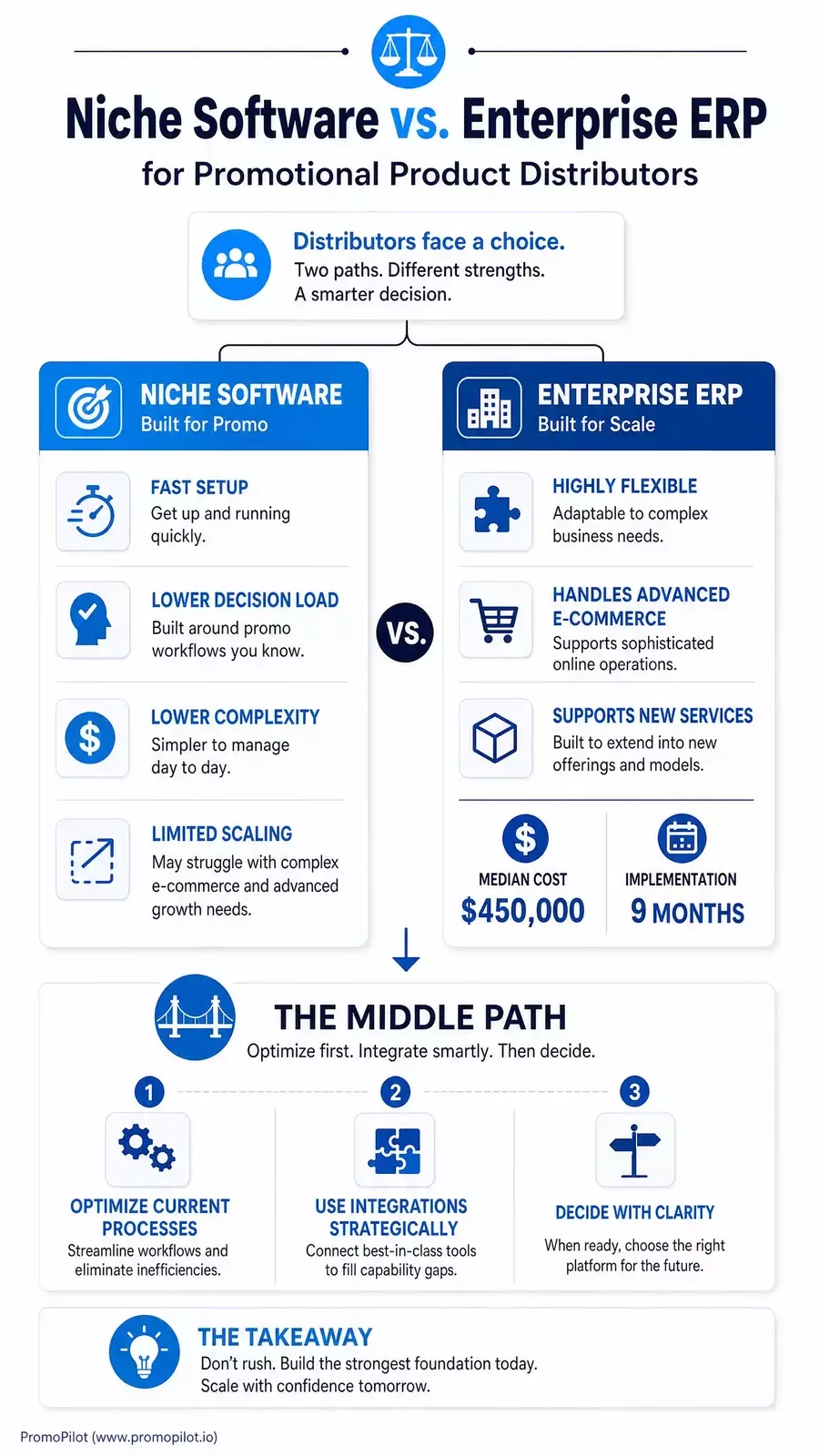
I completely understand why owners choose niche software. It already speaks the language of promo. Many of the odd operational realities of this industry are supported from day one. Supplier workflows make sense. Common program structures are familiar. The team usually needs less translation and less customization to get moving.
That simplicity has real value. Most owners do not want to spend the next nine months in software workshops defining fields, approvals, and workflows from scratch. They want the team trained. They want orders moving. They want a faster path to operational stability.
For many distributors, that is exactly the right choice. If your workflows are relatively standard and your growth does not depend on highly custom operational processes, industry software can be a very strong fit. I do not see that as settling. I see it as pragmatic.
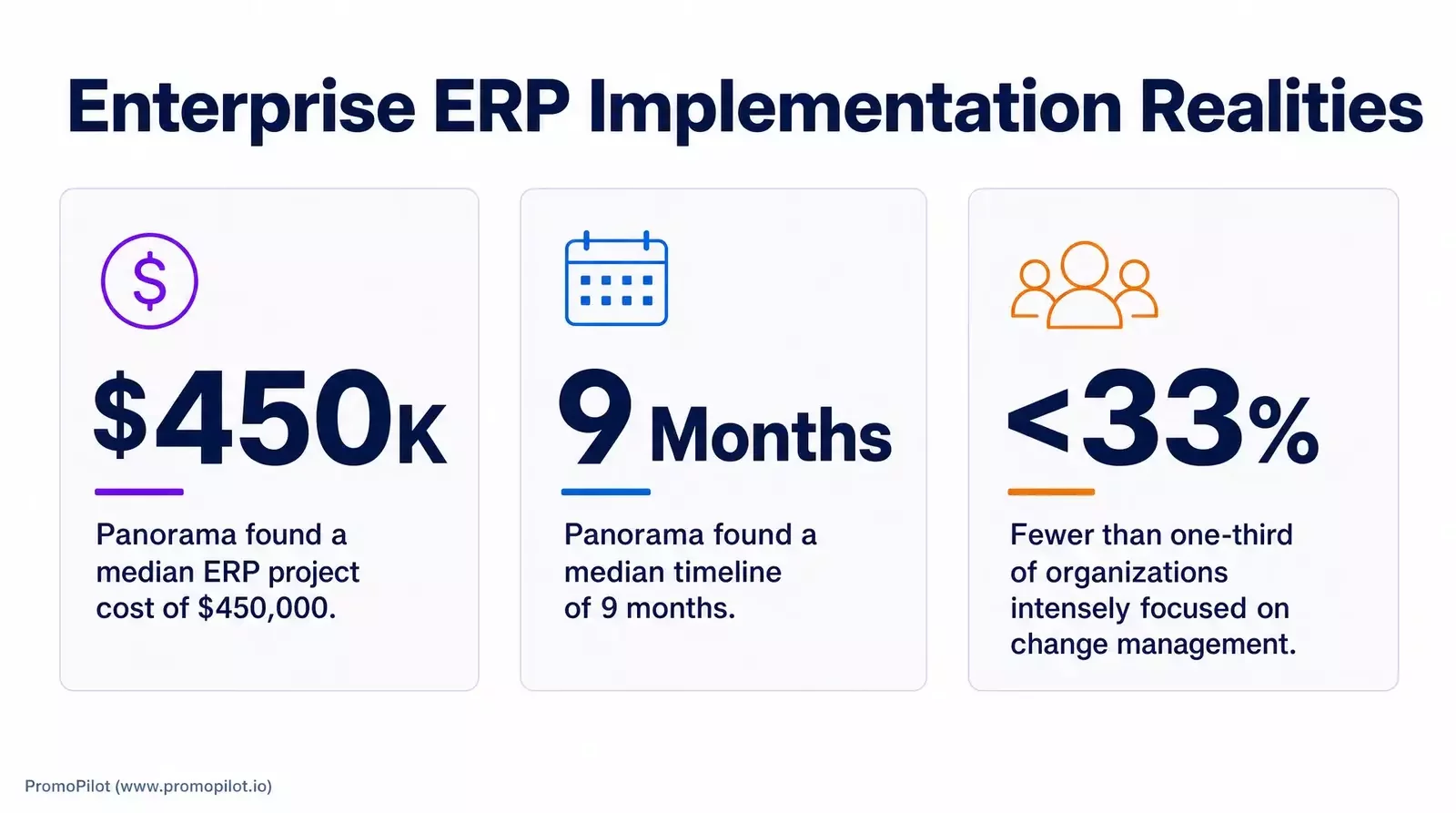
There is also a human side to this decision. Panorama found that fewer than one-third of organizations intensely focused on change management during ERP projects. That matters because even good software can fail if the rollout overwhelms the team. Simpler systems often reduce that implementation burden significantly.
Where Niche Starts to Hold You Back
The tradeoff usually shows up later.
Niche tools can feel tailor-made to your business until the work becomes more complex. I usually see the tension emerge when distributors move deeper into ecommerce, large company-store programs, redemption workflows, or custom client experiences. The operational edge cases start piling up quickly, and the standard lane begins to feel narrow.
There is also a differentiation challenge here. When you use the same supply chain and the same operational software as everyone else, you have to work harder to explain why the client should choose you. Some distributors solve that through exceptional creativity. I think of The Icebox here. Plenty of distributors talk about creativity, but very few execute graphic art and brand design at their level. Others differentiate through technology, logistics, or operational sophistication. Either way, the point is the same: you have to become intentional about where your value lives.
The other issue is roadmap dependency. When you adopt a platform, you are also adopting its priorities. If the vendor's roadmap aligns with your business, that can work well. If it does not, you wait. And while you wait, opportunities can pass by.
That is the hidden cost I think about most. Not inconvenience. Missed capability. A team saying no to work they could probably win because the current system cannot support it.
Integration flexibility matters too. I always want to know how easily a platform communicates with the rest of the stack. Native integrations help. APIs help. Webhooks help. Closed systems usually push the operational burden back onto employees through spreadsheets, manual re-entry, and workaround processes.
Why Enterprise Becomes Attractive
The Good News
Enterprise systems appeal to owners for a different reason: they give you more control over how the business operates.
If your company wants to expand into new service lines, support unusual workflows, or build more custom operational processes, enterprise platforms usually provide more room to do that. Promo-specific systems were largely designed around physical products and traditional distributor workflows. That works well until the business starts moving outside those assumptions.
I often think about service-heavy work here. Media buying, creative retainers, kitting programs, warehousing services, managed storefront programs, or recurring operational fees do not always map cleanly to traditional promo pricing structures. Broader ERP platforms are often better equipped to model those kinds of operational and financial relationships.
There is also a continuity argument that I think matters to owners. Larger ERP ecosystems typically come with broader implementation networks, deeper integration ecosystems, larger developer communities, and more long-term platform investment. From a buyer-confidence standpoint, that matters.
And "enterprise" does not only mean giant corporations. Panorama places Lower Tier II ERP buyers at $10 million to $250 million in revenue. That is a useful reminder for distributors. This conversation often applies squarely to the middle market.
What Enterprise Asks in Return
The cost is real. The timeline is real. The decision load is real.
Panorama found a median ERP project cost of $450,000 and a median timeline of 9 months. This is not a casual software purchase. You are making decisions about workflows, approvals, reporting structures, data ownership, permissions, and operational logic. Some leadership teams are energized by that level of control. Others find it exhausting. I think it is important to be honest about that up front.
The implementation partner matters just as much as the platform. I strongly prefer partners who understand promotional products operationally, not just technically. Outside firms often miss nuances our industry considers obvious.
Inventory ownership is a good example. Just because inventory is physically sitting in a distributor's warehouse does not mean the distributor owns it financially. You can have one order where one line item creates revenue to the distributor while another line item on that same order generates a payable or rebate back to the client. If the implementation team does not understand those distinctions early, accounting logic can become unstable very quickly.
The same pattern shows up in data quality. Panorama found that data integrity and consistency issues were the most common reason ERP projects exceeded schedule, while unexpected technical requirements were the biggest reason budgets expanded. That tracks closely with what I see. Companies often blame the software first, but the real bottleneck is usually upstream in the process design or the data itself.
This is also the stage where some owners start considering custom software. I understand the appeal. But building software and operating a distributorship are very different businesses. Unless custom development creates a genuine competitive advantage, I usually believe distributors should exhaust strong off-the-shelf options first.
Before You Switch, Diagnose the Real Bottleneck
This is the step I wish more companies would take.
Before I recommend changing platforms, I want to know whether the current system has actually been pushed to its limits. A surprising amount of operational pain comes from inconsistent processes, unclear ownership, undocumented workflows, or work being split awkwardly across teams.
I use the word deterministic a lot. What I mean is that a process has clear, repeatable inputs and outputs. If a task is repetitive, frequent, and predictable, it deserves a close look. That is where automation and process design tend to create the most leverage.
I recently untangled a tax liability workflow that was spread across half a dozen spreadsheets. At first glance, it looked like a software problem. Once I traced the workflow end to end, I realized the real issue lived upstream in how the data originated and moved through the organization. Once we identified that, the solution became much clearer.
That is why I keep coming back to process clarity before automation. If a workflow is inherently inconsistent, overly subjective, or missing ownership, automating it usually just scales the confusion.
I also see companies paying for platforms they barely use. The system may already have APIs. It may already support integrations that nobody implemented. Often the real blocker is organizational hesitation, not technical limitation. "We have always done it this way" and "What if it breaks?" are understandable concerns, but they are usually change-management problems, not proof the software itself has failed.
The Middle Path Most Distributors Miss
A full platform switch is not the only move.
In many cases, the better answer is to solve the immediate operational pain with a focused integration or workflow and buy the business more time. That is usually how I approach these situations. I look for native capability first. If that is not enough, I look for a flexible automation layer. Only after that do I start seriously discussing a larger architectural change.
I once helped keep a client on their existing company-store platform by building a custom workflow that recreated functionality they were about to leave for elsewhere. We captured order data, used line-item metadata and custom flags to control logic, and triggered downstream processes even though the platform lacked a clean native API path. That kind of bridge solution can be extremely valuable. It allows the business to keep moving while leadership decides whether the larger platform still fits long term.
When a system is especially closed, I will even use scheduled reports or email-based triggers to move data downstream. It is not glamorous, but it can still be reliable and effective.
If you take this approach, ownership matters. Build workflows in an environment the company controls. Assign clear responsibility for monitoring and maintenance. Avoid shared logins for critical automations because they blur accountability and make troubleshooting harder. I also strongly prefer automated alerts and summary notifications so failures are visible quickly instead of quietly sitting unnoticed for months.
The People Side Matters as Much as the Software

Software decisions fail when leaders ignore the people side.
If Sally is in sales, I want Sally selling. If Sally is also the only person who understands a critical operational workflow, the business has a continuity problem. Important processes cannot live entirely inside one employee's head.
At the same time, the people doing the work are often the best source of operational truth. They know where the exceptions live, where approvals break down, and where human judgment still matters. That is why I strongly prefer involving operations, accounting, and frontline staff early in process mapping and discovery work.
I also do not buy the idea that automation eliminates the human side of business. McKinsey estimated that fewer than 5% of occupations could be fully automated with demonstrated technologies, while roughly 60% contained activities that could be partially automated. That aligns closely with what I see in practice. The goal is usually not replacing people. It is removing repetitive operational work so people can focus on judgment, service, creativity, and relationships.
Long term, I like seeing operational capability develop inside the business itself. I am a big believer in citizen developers and internal process owners. That is one reason I prefer building workflows inside the client's own environment whenever possible. I want the company to own the system and continue evolving it over time, even if that eventually means they need outside help less often.
My Bottom Line
I can make the case for both paths because both paths are valid.
If your workflows are still relatively standard, your team wants faster time to value, and you do not require a high degree of operational customization, industry-specific software can serve you very well for a long time. If your growth depends on advanced ecommerce, sophisticated redemption workflows, broader sourcing models, or service lines that stretch beyond traditional distributor operations, enterprise platforms deserve serious consideration.
I do admire the flexibility of enterprise systems. They give distributors more room to define how the business operates and evolves over time. At the same time, I would not push every distributor in that direction. Many companies will perform better with a strong industry platform that they have fully learned, integrated thoughtfully, and supported with disciplined process design.
So if you are trying to make this decision, start with the business you are actually trying to build. Look at where margin is leaking. Look at where your team spends time on repetitive operational work. Look honestly at whether your current systems support the type of business you want to win next year, not just the business you won last year.
Choose the path that gives you room to scale, keeps your people focused on high-value work, and allows the business to say yes to the right opportunities.
That is the real software decision.