
Automation has come a long way. Not long ago, many of us were excited just to set up simple “if X, then Y” routines to save time. Now all the rage is about smart AI agents that can handle tasks almost like a human assistant. If you're new to these terms, it may feel confusing. The good news is there's a clear way to understand how automation is evolving. It's called the AI Automation Spectrum, and it’s basically a range from straightforward, rule-based workflows to intelligent AI-driven agents. In this beginner-friendly overview, we'll explain what that spectrum is, how it relates to automation, and where platforms like Zapier fit in.
What is the AI Automation Spectrum?
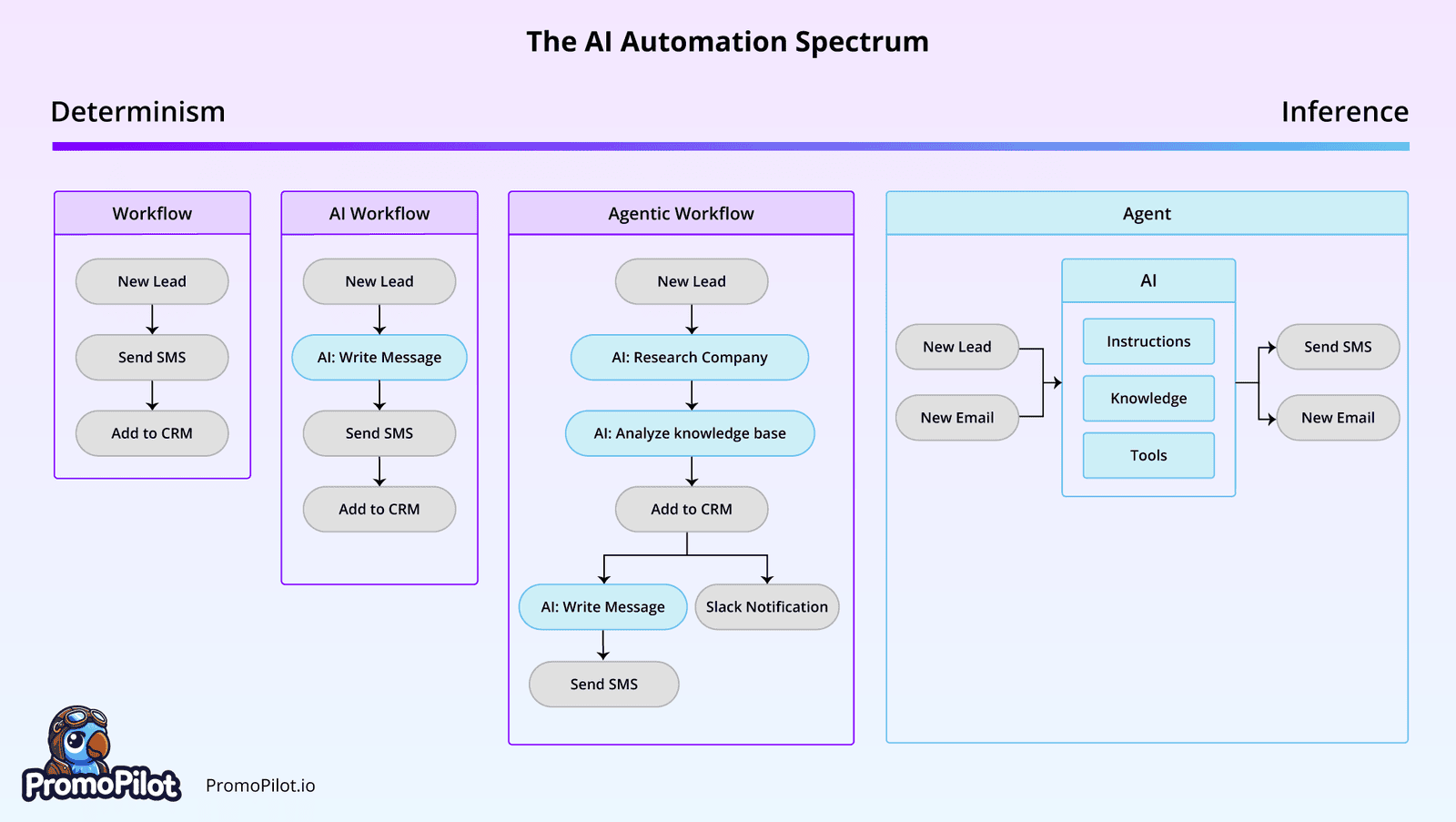
Think of the AI Automation Spectrum as a line with two ends: on one end is deterministic automation (the classic "follow the rules exactly" approach), and on the other end is inference-driven AI (automation that can make its own context-aware decisions). This concept illustrates a framework that shows how automation can range from having zero "brain" (just following preset rules) to having a lot of "brain" (AI that figures things out on the fly).
The Four Levels of Automation
Let's break down the spectrum into four basic levels, from the simplest automation to the most intelligent:
Workflow (Deterministic Automation): This is your basic automation with zero "thinking" involved. The process follows a strict, pre-defined sequence of actions every time. For example, you might set up a workflow so that when a new lead comes in, it automatically sends a text message and then adds the lead to your CRM. There's no AI here – it's just if-this-then-that rules, which makes it fast and reliable for routine tasks.
AI Workflow (Automation with a Hint of AI): Here, the overall workflow is still pre-defined, but you let AI handle one step of the process. In other words, it's a normal automation "with a sprinkle of AI." For instance, you could keep the same lead follow-up workflow as above but use an AI to write the message content instead of using a fixed template. The structure (when lead comes → send message → add to CRM) doesn't change, but an AI adds a bit of intelligence at one point (like personalizing the message). This makes the automation more adaptable without losing predictability.
"Agentic" Workflow (Automation with Multiple AI Decisions): At this level, you still have a clear workflow structure, but the AI steps in at several points to make judgments or decisions. It's a blend of automation and AI working within set guardrails. Continuing our example, an agentic workflow might, upon a new lead, have the AI research the lead's company or analyze your knowledge base, decide what kind of follow-up to write, then maybe send a Slack notification to your team before texting the lead. There are multiple AI-driven actions, but they occur in a sequence you've outlined. This approach handles more complex tasks (with the AI adapting to context) while still following a reliable pattern you control. It's not only generating content this time – it's taking action by conducting research and getting information from your apps.
Agent (Autonomous AI Assistant): This is the far-right end of the spectrum – an AI agent with a lot of autonomy. You don't script out the entire workflow step by step; instead, you give the AI a goal or high-level instruction, and the agent decides how to achieve it. It's like putting the AI on autopilot (with some safety boundaries in place). For example, you might simply tell the agent, "Please follow up with new leads." From there, the agent will figure out the rest: it could choose to send an email or an SMS, update the CRM, schedule a call, or all of the above, based on the context – without you explicitly telling it which to do first. This level is the most powerful and flexible, but it’s also the least predictable. Fully autonomous agents are exciting, but they require good guidance (and often a bit of oversight) to ensure they stay on track.
Where do platforms like Zapier fit in?
You might be wondering how this spectrum works in practice and where popular automation tools fit on it. Platforms like Zapier have traditionally lived on the left side of the spectrum, helping users build classic workflows that connect apps (for example, Zaps that move info from a form to a spreadsheet, then send an email). Over time, these platforms have added more intelligence. Zapier now lets you incorporate AI into your workflows – for instance, using an AI step to draft content – which is the AI Workflow level. Recently, Zapier even introduced Zapier AI Agents, which are more in the agentic territory, allowing an AI to perform research or multi-step decisions within your automation. In other words, the tool is evolving to cover the middle of the spectrum and inch toward the agent side, all while giving you control over the process.
Importantly, the AI Automation Spectrum is a general idea. The key is to choose the right level of automation for your task. Simple, rule-based workflows (left side) are great for straightforward, repetitive jobs. As tasks get more complex or require some judgment, moving to an AI Workflow or Agentic Workflow can save time and add smarts. And for open-ended tasks where you'd want an assistant to figure out the steps, an AI Agent (right side) might be the goal. Knowing where you need to be on this spectrum can make the difference between wasting effort and actually moving the needle for your business.
The AI Automation Spectrum gives you a handy mental model for automation in the age of AI. You don't have to jump straight to building a super-intelligent agent. You can start small – maybe add one AI-powered step to an existing workflow – and gradually explore more "agentic" solutions as you grow comfortable. The exciting part is seeing your mundane tasks get smarter and your complex tasks get easier.